


Quick Answer: What Are 7109 Color Frosted Microscope Slides Used For?
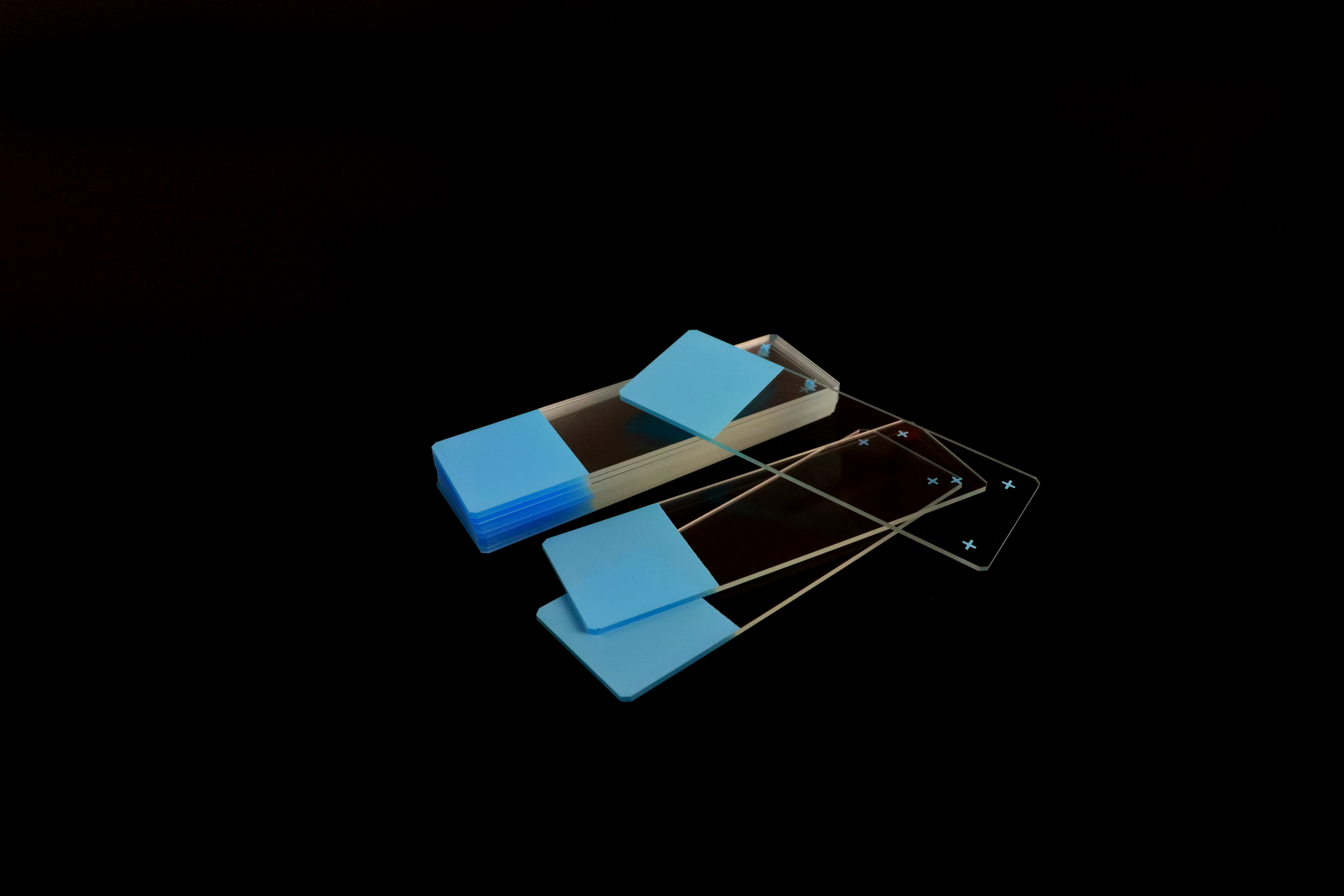
7109 color frosted microscope slides are used to hold specimens for microscopic examination while providing a colored marking area for labeling, visual sorting and identification. Common applications include histology, pathology, cytology, research and teaching. Suitable configurations also support direct slide printing.OEM Glass Factory
Their main identification feature is the colored end. The clear glass area holds the specimen, while the marking area carries information such as a sample ID, section number or project reference.
For procedures requiring enhanced specimen adhesion, specify the appropriate charged or adhesive surface separately. A colored marking area alone does not establish tissue-retention performance.
What Are 7109 Color Frosted Microscope Slides?
In Chuangxin Medlab’s catalogue, 7109 identifies microscope slides with a color frosted marking area at one end.
The slide has two main working areas:
Clear specimen area: holds the preparation to be examined under the microscope.
Colored marking area: provides a defined space for identification, using a suitable writing tool or compatible printing system.
The color is concentrated at the marking end. It gives laboratories an additional way to organize slides without covering the specimen area.
When ordering, confirm the complete configuration, including dimensions, glass grade, edge finish, corner geometry, marking-area color and any required specimen-adhesion treatment.
The product code is a starting point for an enquiry. The written specification should define the slide the laboratory will receive.
Main Applications of 7109 Color Frosted Microscope Slides
Histology and Pathology Slide Identification
Histology work can involve multiple blocks, sections and slides associated with the same case or study. The marking end provides space to distinguish these preparations.
Depending on the laboratory’s procedure, the identifier may include an accession reference, block designation, slide number or stain designation.
A color frosted end can also support a laboratory’s agreed sorting system. For example, a laboratory might use different colors for separate work streams while retaining the required identifiers on every slide.
Select the specimen-contact surface according to the preparation and staining procedure. The marking color and tissue-adhesion requirements should be recorded as separate specifications.
Cytology Preparations
Color frosted slides can help organize cytology smears and other cell preparations when their glass and surface specifications suit the method.
The colored end provides a consistent location for the preparation’s identifier. This is useful when a specimen produces several slides that need to remain distinguishable during handling and review.
Confirm the appropriate surface treatment for the preparation method. A slide suitable for identification purposes still needs to meet the laboratory’s specimen-retention requirements. Colored marking ends are used across histology, cytology and other microscopy applications.
Routine Laboratory Microscopy
In routine microscopy, clear identification helps users distinguish preparations in racks, trays and storage boxes.
7109 slides can be considered when the laboratory needs a defined marking area and a visual sorting cue alongside the specimen ID.
For example, a laboratory could assign different tab colors to separate preparation batches. Each slide should still carry the identifier required by the laboratory’s procedure.
The benefit comes from applying a consistent identification system throughout preparation, examination and storage.
Research Projects and Experimental Series
Research laboratories often handle slides from different experiments, time points or replicate preparations.
A color-based organization scheme can help staff visually separate these groups. A research team might assign blue marking ends to Project A and green marking ends to Project B, then identify each individual preparation with a unique code.
Keep the color assignments documented and consistent within the project. Include the written slide ID in the experimental record so the preparation remains identifiable outside its original rack or batch.
These are examples of possible laboratory arrangements; color meanings should be defined locally.
Teaching and Training
Teaching laboratories can use colored marking ends to organize slide sets by practical session, specimen group or preparation exercise.
This can make it easier to distribute and collect a defined set of slides, especially when several groups work at the same time.
Written identification remains useful when a slide is separated from the rest of its set. Choose the slide type and handling procedure appropriate to the exercise.
A colored marking end is an organizational feature. It does not change the basic precautions required when handling glass.
Printed Identification and Digital Records
A compatible color frosted surface can carry printed identifiers used within an established laboratory tracking workflow.
Depending on the printer and software, this may include readable text, a barcode or a two-dimensional code. Such identifiers can connect a physical slide with its electronic record when the laboratory’s systems are configured accordingly.
Confirm both printing and reading performance. The slide, printer, settings, code layout and scanning system need to work together.
The colored end provides the marking surface; the wider identification system provides the connection to the laboratory record.
How Does Color Coding Help Laboratory Organization?
Color provides an additional visual cue for sorting and handling slides. The written or printed identifier remains the reference for identifying an individual preparation.
A practical color scheme should be simple enough for staff to use consistently.
Before introducing one, decide:
What each color represents.
Which slides belong in each category.
Where the assignment is documented.
How individual preparations will be identified.
How exceptions or changes will be recorded.
For example, assigning blue to one research project and green to another can help users separate the two groups at a glance. The project name and specimen ID should still be recorded.
Avoid assuming that a color carries the same meaning in another laboratory. A purchasing specification should state the required color without relying on an unstated clinical or departmental meaning.
Can 7109 Color Frosted Slides Be Used with Slide Printers?
Chuangxin Medlab lists thermal transfer, inkjet and laser marking among its 7109 printing options. Confirm compatibility for the selected slide configuration and the actual printer model.OEM Glass Factory
The three methods place different demands on a marking surface. A sample evaluation should use the intended equipment, consumables and settings. Printer manufacturers also distinguish between surfaces optimized for different printing technologies.
Identification method | What to confirm before approval |
|---|---|
Handwriting | Suitable marker or pencil, legibility and resistance to the intended processing conditions |
Thermal transfer printing | Printer model, ribbon, settings, print transfer and slide feeding |
Inkjet printing | Ink system, drying behavior, contrast and durability during processing |
Laser marking | Laser system, marking-area formulation, settings and readable marking results |
The word “printable” should be supported by information about the intended printing method.
When requesting samples, provide the printer manufacturer and model, the slide dimensions required by the instrument and the marking-area color. Explain whether the laboratory needs text, barcodes or another supported code format.
Evaluate readability before and after the relevant workflow. For machine-readable codes, check recognition with the laboratory’s actual reader or scanner.
A successful test on one printer or one slide color should be documented for that configuration. Review proposed changes before adopting them in routine purchasing.
Are Color Frosted Slides the Same as Positively Charged Slides?
Color frosting describes the marking area. Positively charged or another adhesive treatment describes a separate property of the specimen-contact surface.
A slide can combine a colored marking end with a charged or adhesive specimen area. The purchase specification needs to identify both features when both are required. Manufacturer product ranges distinguish marking features from adhesion characteristics.Chuangxin Medlab
Feature | Main purpose | Purchasing question |
|---|---|---|
Color frosted marking end | Identification and visual organization | Which color, marking-area dimensions and writing or printing method are required? |
Positively charged specimen surface | Supports specimen adhesion in appropriate applications | Which charged product and validated laboratory procedure apply? |
Other adhesive surface treatment | Provides specified adhesion characteristics | What treatment and product instructions are required? |
For IHC, in situ hybridization or other procedures with demanding specimen-retention requirements, follow the laboratory’s approved slide specification.
If a procedure requires enhanced adhesion, ask for a suitable charged or adhesive grade with the required marking end. Color selection alone does not answer the adhesion question.
How Do 7109 Slides Compare with Plain and Frosted Slides?
Choose the identification feature according to the workflow, then specify the specimen surface separately.
Slide type | Identification feature | Typical purchasing consideration |
|---|---|---|
No dedicated frosted marking area on a conventional plain configuration | Suitable when the identification method does not require a frosted tab | |
Defined frosted marking area | Useful for an established writing or labeling procedure | |
Colored marking area at one end | Useful when identification and visual sorting are both required | |
Specified specimen-adhesion treatment; marking-end options depend on the product | Selected when the procedure requires the particular surface treatment |
These descriptions cover different product characteristics. A charged slide may also have a colored marking end.
For bulk purchases, compare products with the same dimensions, edge finish, surface treatment and packaging. A shared color or similar photograph is insufficient to establish an equivalent replacement.
What Specifications Should Buyers Confirm?
Chuangxin Medlab publishes the following options for its 7109 range:
Item | Published option or specification |
|---|---|
Slide sizes | 25 × 75 mm; 25.4 × 76.2 mm; 26 × 76 mm |
Thickness | 1.0–1.2 mm |
Glass options | Soda lime glass or super white glass |
Edge finish | Ground edges |
Corners | 45° or 90° options |
Marking area | One color frosted end on one side |
Colors | White, blue, green, yellow, pink, orange and custom colors |
Packaging | 50, 72 slides per box |
Branding | OEM and private label enquiries available |
These are published product options; confirm the configuration for the actual order.OEM Glass Factory
Use these options to prepare a specific enquiry. The quotation and purchase order should identify one agreed configuration.
Also confirm:
The required dimensional tolerances.
Marking-area size and position.
Any additional specimen-surface treatment.
Printer model and relevant compatibility information.
Pieces per box and boxes per outer carton.
Product and batch identification.
Current technical documentation for the intended use.
A published thickness range is a starting specification. Equipment with tighter requirements may need additional dimensional information.
How Should Laboratories Evaluate Samples Before Bulk Ordering?
A sample trial should reflect the intended workflow and the specification the supplier has quoted.
Check the Physical Slide
Review dimensions, thickness, edges and corners. Inspect the clear area for visible contamination, scratches, chips or other defects that affect the agreed requirements.
Check the marking area’s position and consistency across the sample set.
Check the Identification Method
Write or print the information the laboratory intends to use. Review text clarity, smudging, incomplete printing and code readability.
When several colors are being purchased, include each selected color in the evaluation.
Check the Intended Processing Conditions
Evaluate the marking through the relevant laboratory workflow. Record whether the identification remains readable and whether the marking area meets the agreed requirements.
For charged or adhesive products, assess specimen retention using the laboratory’s approved procedure.
Check Equipment Handling
Where applicable, evaluate slide feeding, holder fit, printing and code reading with the intended equipment.
Record the product configuration and equipment settings associated with the result.
Keep the Approval Record
Retain the approved specification, product reference, sample assessment and packaging details.
This record helps the laboratory and distributor review subsequent orders and proposed changes. It also gives the supplier a clearer basis for maintaining the agreed configuration.
7109 Color Frosted Microscope Slides from Chuangxin Medlab
Yancheng Chuangxin Medlab Co., Ltd. manufactures and supplies microscope slides, cover glass and laboratory consumables under the S.D.T.C. brand.Chuangxin Medlab
For laboratories and distributors, a 7109 enquiry can cover the required dimensions, marking color, printing method, packaging and repeat-order identification.
For OEM and private label projects, the discussion can also include box artwork, labels and the proposed product range.
Explore our 7109 Color Frosted Microscope Slides, or review our microscope slide portfolio to compare the available product types.
Frequently Asked Questions
What is the main purpose of 7109 color frosted microscope slides?
They hold specimens for microscopy and provide a colored marking area for identification. Laboratories can use the marking end for suitable handwriting or printing, with color serving as an additional sorting cue.
Are 7109 slides suitable for histology and cytology?
They can be considered for these applications when the complete slide specification matches the procedure. Confirm the specimen-contact surface, dimensions and identification method required by the laboratory.
Can 7109 slides be used for IHC?
The colored end alone does not establish IHC suitability. Select the charged or adhesive surface required by the approved procedure, then confirm the desired marking color and printing configuration.
Can every 7109 slide be used with every slide printer?
Compatibility should be confirmed for the exact slide configuration and printer model. Evaluate the chosen marking color, printing method, consumables and settings before routine use.
Does the colored marking area improve the microscope image?
The marking end helps with identification and organization. Imaging performance depends on factors such as glass quality, specimen preparation and the microscope setup; the marking color alone does not determine it.
Can distributors request customized 7109 slides?
Chuangxin Medlab accepts OEM and private label enquiries. Send the proposed dimensions, marking color, printing requirements, quantity and packaging details for a project-specific response.
Request 7109 Color Frosted Slide Samples or a Quotation
Choosing a suitable 7109 slide starts with the laboratory’s identification method and specimen-preparation requirements.
Send Chuangxin Medlab the required size, thickness, marking-area color, printer model if applicable, surface treatment, quantity and packaging.
Our team can review the specification and discuss sample availability, OEM requirements and quotation terms.
Contact Chuangxin Medlab about 7109 color frosted microscope slides.