


Standard Microscope Slide Sizes: A Practical Guide for Buyers
A microscope slide needs to fit the entire laboratory workflow, from specimen preparation and staining to printing, scanning, storage and transport. A product described simply as “standard size” may leave important details unresolved.
For laboratories, distributors and importers, the most useful specification includes the slide's length, width, thickness, tolerances, edge finish and marking area. This guide explains the common formats and how to confirm the right size before ordering.
Quick Answer: What Is the Standard Microscope Slide Size?
Common microscope slide formats include 25 × 75 mm, 26 × 76 mm and 25.4 × 76.2 mm. The last format is the exact metric equivalent of 1 × 3 inches.
Many routine slides are supplied at approximately 1.0–1.2 mm thick, depending on the product specification. This is a commonly offered range, rather than a universal requirement for every slide or instrument.
Confirm the exact dimensions and acceptable limits for the intended equipment before purchasing.
Common Slide Dimensions and Inch Conversions
The table below lists dimensions as width × length.
Nominal Format | Relationship to 1 × 3 Inches | Purchasing Consideration |
|---|---|---|
25.4 × 76.2 mm | Exact metric conversion | Specify this format when exact inch dimensions are required |
25 × 75 mm | Common metric format, close to 1 × 3 inches | Confirm the equipment accepts this nominal size |
26 × 76 mm | Another common metric format | Verify width, length and permitted variation |
One inch equals exactly 25.4 mm. Therefore, a 25 × 75 mm slide and a 25.4 × 76.2 mm slide have different nominal dimensions, even if a catalog describes both informally as 1 × 3-inch slides.
Use the manufacturer's datasheet and the equipment requirements to resolve the final specification.
Length, Width and Thickness: Read the Order Carefully
Suppliers may present dimensions in different orders. A specification written as 75 × 25 × 1 mm usually describes length, width and thickness, while a two-dimensional listing may put width first.
To prevent misunderstandings, label all three measurements in the purchase specification:
Length: The longer dimension of the slide
Width: The shorter dimension
Thickness: The depth of the glass
For example, “length 75 mm × width 25 mm, thickness 1.0–1.2 mm” is clearer than an unlabeled sequence of numbers.
Include the unit of measurement throughout quotations, samples and purchase orders.
What Thickness Should a Microscope Slide Have?
Around 1 mm is common for routine microscope slides, and some products are specified within a 1.0–1.2 mm range. Other thickness specifications may be available for particular products or applications.
Buyers should distinguish three details:
Specification | What It Describes |
|---|---|
Nominal thickness | The stated target or product description |
Accepted range or tolerance | The permitted limits agreed for the order |
Measured thickness | The result obtained from an inspected sample |
A catalog thickness range should not be treated as proof that every instrument will accept that range. Check the relevant manual or equipment supplier's requirements.
When consistency matters, ask how thickness is measured and controlled across the batch.
Why Equipment Compatibility Matters
Slide dimensions can affect fit in microscope stages, staining racks, printers, scanners, storage boxes and transport containers.
Check the complete chain of use. A slide that fits a microscope stage may still be unsuitable for a printer or automated slide handling system.
Before supplier approval, confirm:
Permitted length, width and thickness
Required corner style and edge finish
Marking-area position and usable print area
Any restrictions on surface treatment or labels
Test representative samples in the actual equipment where compatibility is important. Similar overall dimensions alone do not establish equivalent performance.
Do Plain, Frosted and Charged Slides Use Different Sizes?
Several slide types can be offered in the same nominal dimensions:
Plain Microscope Slides provide a clear format for routine preparations.
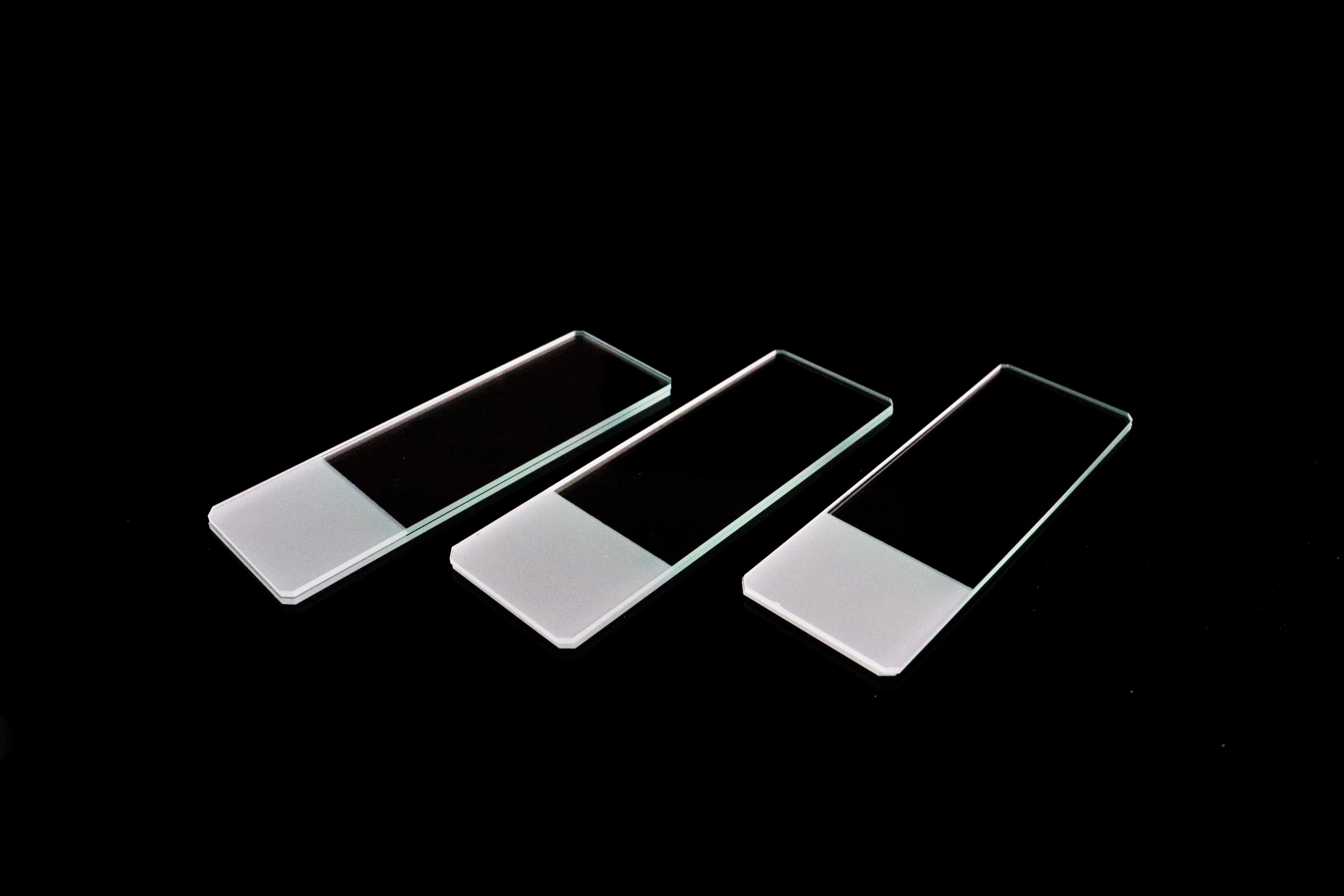
Frosted Microscope Slides include a marking area.
Color Frosted Microscope Slides add a colored identification area.
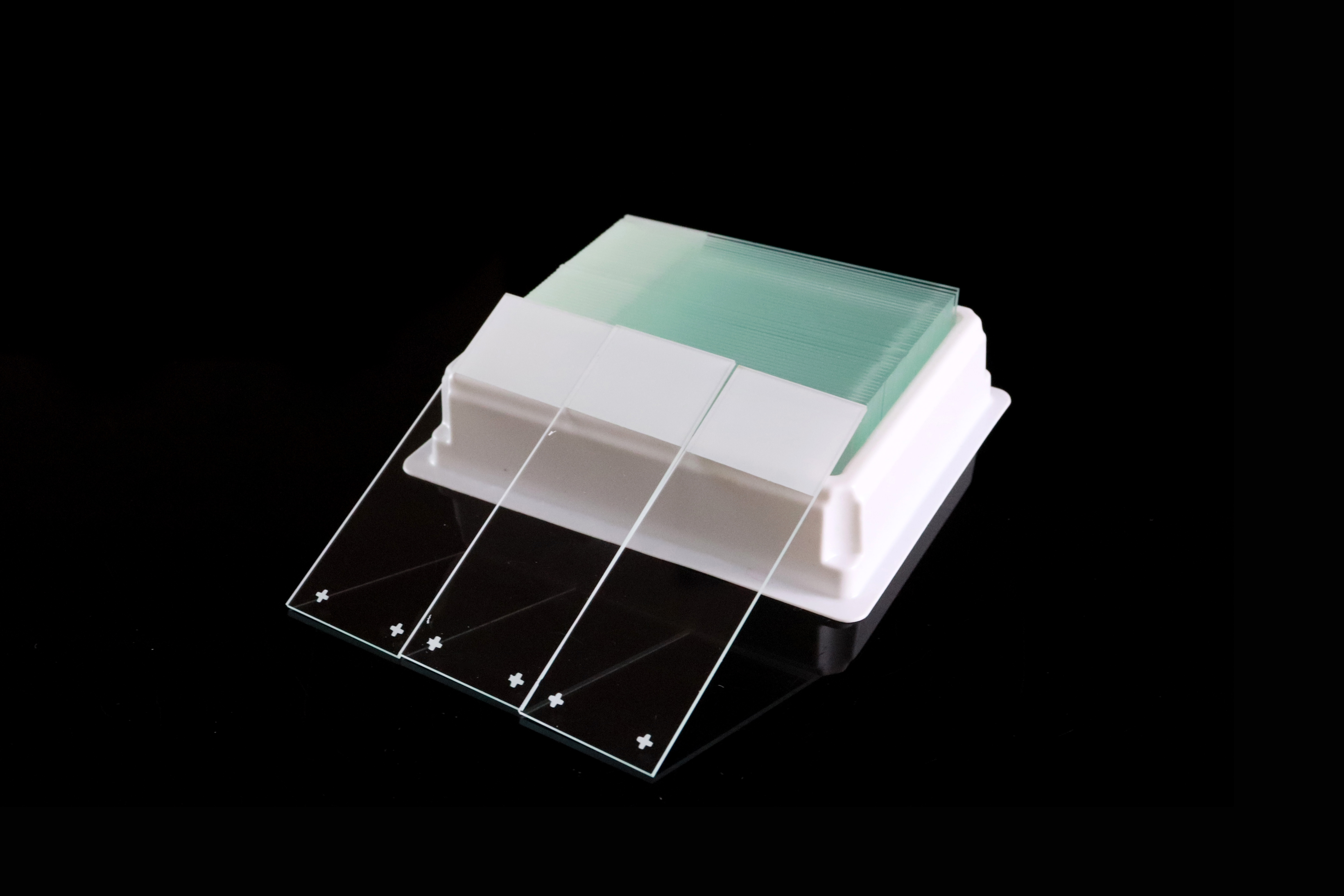
Positively Charged Microscope Slides have a surface treatment intended to enhance specimen adhesion.
Dimensions, marking format and specimen-surface treatment are separate choices. Confirm each feature for the selected model.


Specify the Marking Area and Edges Separately
The overall slide size does not describe the size of its marking area. Frosted-area length, position, texture and whether one or both sides are processed can vary.
For printed identification, assess the intended printer and marking supplies together with the slide. A similar-looking marking area may not perform identically.
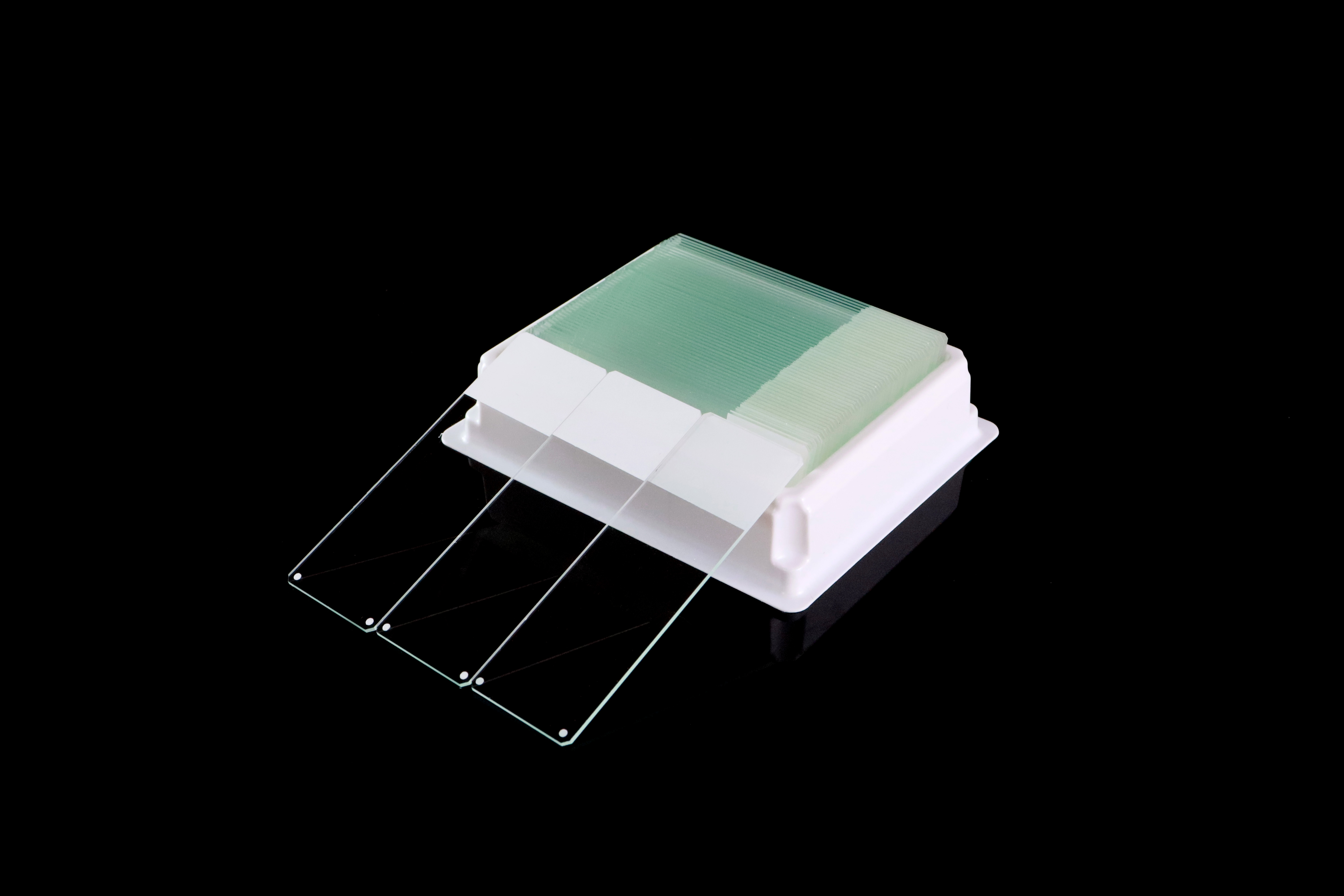
Likewise, cut edges and ground edges describe finishing rather than a particular slide size. Confirm the finished dimensions and selected corner style after edge processing.
These details help keep samples, production and repeat orders aligned.
Slide Size and Cover Glass Size Serve Different Purposes
The slide supports the specimen. Cover glass is a separate, much thinner component placed over many microscope preparations.
Common cover glass formats include 18 × 18 mm, 20 × 20 mm, 22 × 22 mm and 24 × 24 mm, as well as rectangular sizes such as 24 × 32 mm, 24 × 40 mm, 24 × 50 mm and 24 × 60 mm.
Select cover glass according to the specimen area, mounting method and optical requirements. A slide's overall dimensions do not determine the correct cover glass size or thickness by themselves.
A Size Checklist for Bulk Purchasing
Before requesting a quotation, provide the following:
Item | What to Specify |
|---|---|
Slide model | Plain, frosted, color frosted or treated |
Glass | Required material or grade |
Dimensions | Length and width, with units |
Thickness | Required target or accepted range |
Tolerances | Agreed limits for the relevant measurements |
Finish | Edge type and corner style |
Marking area | Position, size, sides and color |
Application | Equipment and preparation method where relevant |
Packaging | Slides per box, carton configuration and order quantity |
Compare samples against this written specification. Retain the approved details so that repeat orders use the same reference.
Microscope Slide Specifications from Chuangxin Medlab
Yancheng Chuangxin Medlab Co., Ltd. supplies microscope slides for laboratories, pathology and histology departments, distributors, importers and OEM customers.
Available specifications include common metric and inch-based formats, with glass, edges, marking areas and surface treatments selected according to the product.
For bulk orders, we support specification discussions, sample evaluation and packaging requirements. Confirm the exact dimensions and tolerances for the selected model before production.
Frequently Asked Questions
Is 25 × 75 mm exactly the same as 1 × 3 inches?
The exact conversion of 1 × 3 inches is 25.4 × 76.2 mm. The formats are close, but they have different nominal dimensions.
Are all microscope slides 1 mm thick?
Thickness depends on the product. Around 1 mm is common, while some products specify a 1.0–1.2 mm range. Confirm the required limits for the intended application.
Can the same slide size be used for microscopy and scanning?
Possibly, but the scanner may have additional requirements for thickness, flatness, corners, marking areas or labels. Check the specific system and evaluate samples.
Does a frosted marking area change the overall slide dimensions?
Frosting is a separate feature. A frosted slide can share the same overall size as a plain slide, but both dimensions and marking-area specifications should be confirmed.
Confirm the Right Size Before Ordering
Specify the full slide configuration instead of relying on the phrase “standard microscope slide.” Clear dimensions, accepted limits and sample approval make it easier to source a product that fits the laboratory workflow.
Contact Chuangxin Medlab with your required size, thickness, slide type, equipment requirements and quantity to discuss samples or a bulk quotation.