






Quick Answer: How Do You Buy Microscope Slides in Bulk?
To buy microscope slides in bulk, define the application and product specifications, evaluate representative samples, and compare quotations for the same quantity and configuration. Before placing the order, agree on quality requirements, packaging, OEM artwork where applicable, and delivery terms.
For distributors and importers, the goal is a product that can be ordered repeatedly with consistent specifications. This guide explains how to move from an initial enquiry to an approved bulk order and a practical replenishment plan.
1. Choose the Microscope Slide Type for Your Application
Begin with the laboratory workflow or the requirements of your customers. A clear product description helps the supplier propose a suitable model and makes quotations easier to compare.
Slide type | Requirement it addresses | What buyers should evaluate |
|---|---|---|
General specimen preparation, routine microscopy, and teaching | Glass dimensions, cleanliness, flatness, and edge finish | |
A marking area for specimen identification | Frosted-area dimensions, side, and writing performance | |
Color coding and specimen labeling | Color, marking durability, and the intended printing method | |
Tissue-section adhesion requirements | Tissue retention, staining background, and workflow compatibility | |
Applications requiring a specified adhesive surface | The exact surface treatment and performance in the intended procedure |



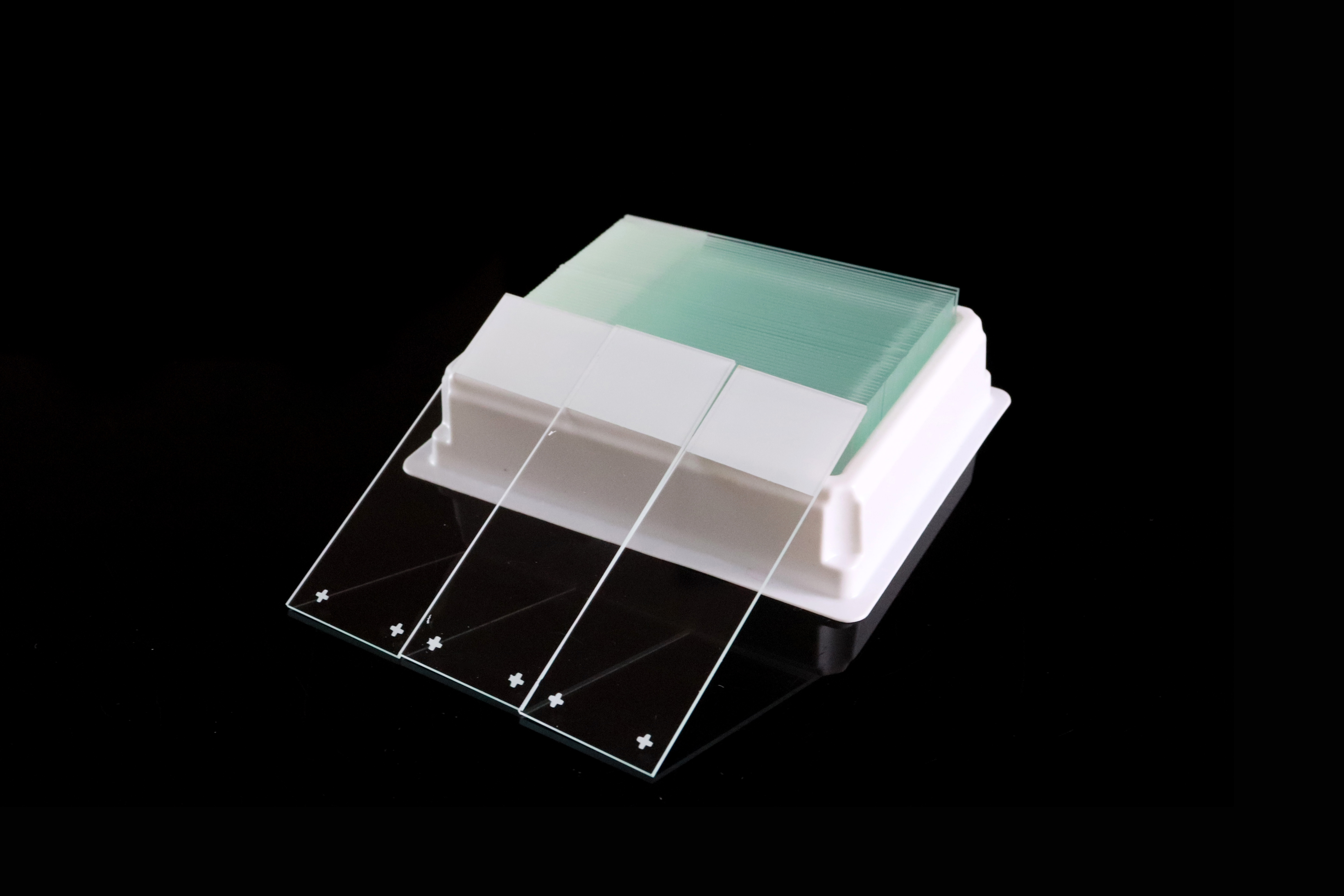
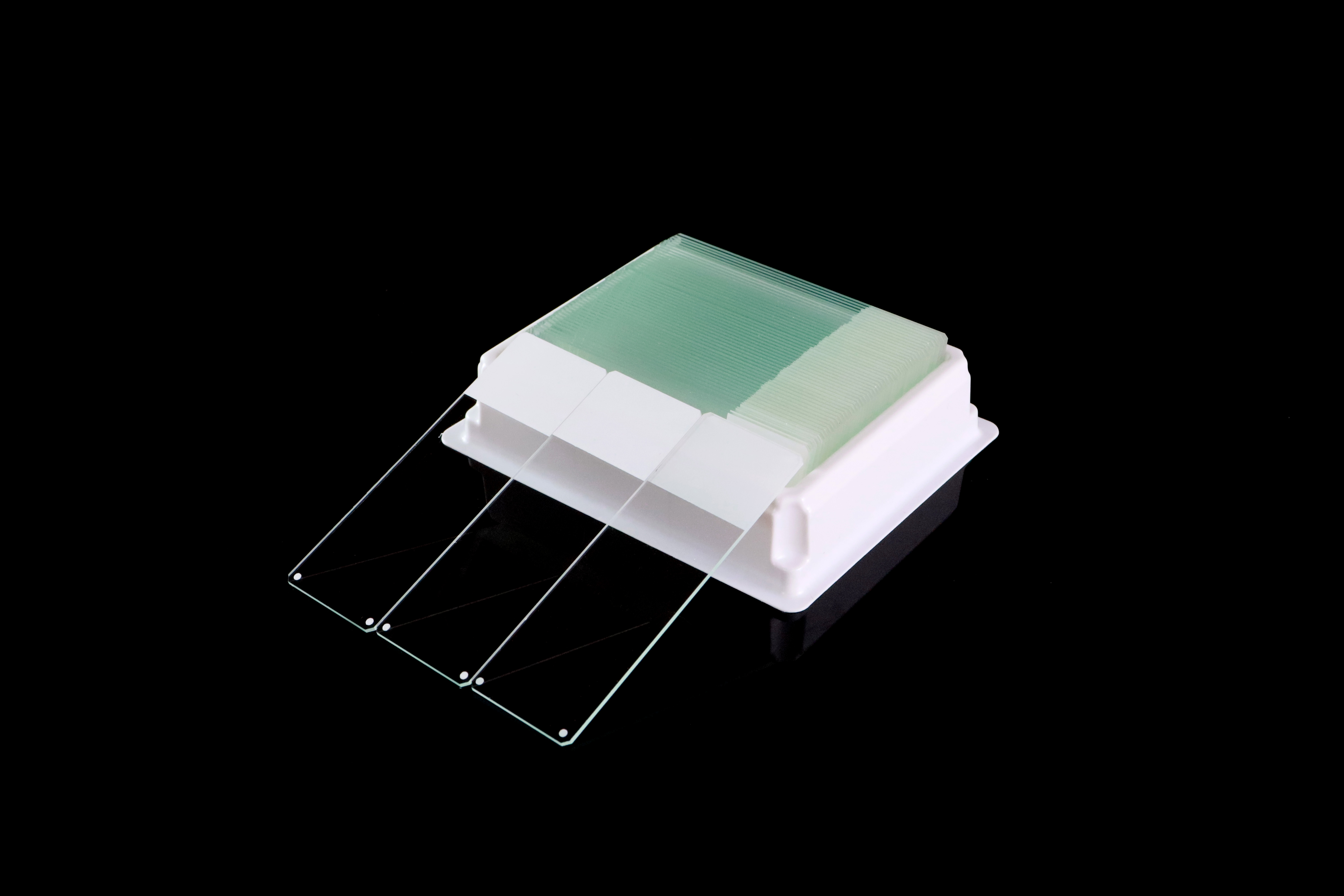
For a mixed order, list each slide type as a separate line item with its own specifications and quantity. For coated slides, approve the exact model for the intended workflow before committing to a large purchase.
2. Define the Glass, Dimensions, Edges, and Surface Treatment
Complete specifications reduce avoidable differences between the requested product, the quotation, and the delivered goods.
Common microscope slide formats include 25 × 75 mm, 25.4 × 76.2 mm (1 × 3 inches), and 26 × 76 mm. Published Chuangxin Medlab standard plain-slide specifications include a thickness range of 1.0–1.2 mm. Confirm the dimensions and tolerances of the selected model, particularly when slides will be used in automated equipment.
Include these details in the specification:
Glass material or grade: State the required material and any relevant optical requirements. Ask the supplier to explain its glass-grade terminology.
Dimensions and thickness: Give length, width, thickness, and acceptable tolerances in consistent units.
Edges and corners: Specify the edge finish separately from the corner shape. Attach a drawing when an angle designation could be interpreted differently.
Marking area: Confirm the area size, side, color, and intended writing or printing method.
Surface treatment: Identify the required coating or surface properties and the application to be evaluated.
A thickness range is different from a manufacturing tolerance. Record the requirement clearly rather than relying on the word “standard.”
3. Qualify the Manufacturer or Supplier
A manufacturer, distributor, or wholesaler may be appropriate depending on the order. Factory enquiries can be useful for custom specifications and packaging, while a distributor may suit buyers who need local stock or consolidated purchasing.
For either route, establish who makes the slides and who is responsible for meeting the purchase specification.
Ask the supplier:
Can you identify the manufacturer and exact catalog number?
Which manufacturing or supply activities do you carry out directly?
How are product changes communicated and approved?
What documentation can you provide for the proposed model?
Can you confirm current capacity, sample availability, and delivery timing for this order?
Use model-specific evidence to assess capability. A broad product catalog or a general company certificate should be considered alongside the actual slide specification and sample results.
4. Evaluate Samples and Record the Approved Configuration
Request samples that represent the proposed glass, surface treatment, labeling area, and packaging. Record the model and lot details supplied with them.
During evaluation, check:
Dimensions, thickness, and fit in the intended equipment.
Surface cleanliness, visible scratches, chips, and edge finishing.
Flatness and appearance under the laboratory's inspection procedure.
Writing, label adhesion, or printing performance where applicable.
Tissue retention and staining performance for charged or adhesive models.
Box configuration, separation of slides, and handling during unpacking.
For specialized applications, define acceptance criteria with the laboratory before testing. Once the sample is approved, retain the specification, evaluation record, and reference sample where practical.
Include the approved configuration in the purchase order. If a supplier proposes a material, coating, dimension, or packaging change, review it before production proceeds.
5. Separate MOQ, Order Quantity, and Reorder Point
These three quantities answer different purchasing questions:
Minimum order quantity (MOQ): The smallest order the supplier will accept for a product or configuration.
Order quantity: The amount you choose to purchase based on demand, stock, budget, and packing requirements.
Reorder point: The inventory level that triggers replenishment under your purchasing policy.
Ask whether MOQ applies per model, color, packaging design, or complete order. Confirm any separate minimum for custom boxes, printed labels, or another OEM component.
A basic replenishment calculation is:
Reorder point = Average daily demand × Replenishment lead time in days + Safety stock
Keep demand and safety stock in the same unit, such as boxes. This approach is reflected in Oracle NetSuite's reorder-point calculation. Inventory Optimization Calculations
Illustrative example: At an average demand of 50 boxes per day, a replenishment lead time of 40 days, and a chosen safety stock of 500 boxes, the reorder point is 50 × 40 + 500 = 2,500 boxes.
This is a replenishment trigger, not the recommended order quantity. Review on-hand stock, open purchase orders, backorders, demand changes, and the full replenishment timeline when applying it.
6. Compare Bulk Prices on an Equivalent Basis
Before comparing prices, check that each quotation covers the same glass specification, surface treatment, packing, and total number of slides.
Box prices can be misleading when pack quantities differ. For example, 100 boxes containing 50 slides each represent 5,000 slides, while 100 boxes containing 72 slides each represent 7,200 slides.
Normalize offers to a common quantity, such as the price per 1,000 slides, and record:
Currency, quote validity, and quantity tier.
Slides per box and boxes per carton.
Standard or customized packaging costs.
Sample, artwork, or setup charges where applicable.
Freight, insurance, and other charges included in the offer.
Delivery destination and responsibility for import clearance and local delivery.
Compare the delivered cost of the approved product configuration. Include the practical effect of receiving defects, shortages, or an unsuitable substitute in your supplier evaluation.
7. Approve OEM and Private-Label Details Before Production
If you are developing a distributor brand, discuss OEM requirements early enough to include them in the quotation and sample plan.
Possible customization topics include box artwork, customer logos, product labels, barcodes, carton markings, and selected slide specifications. Confirm feasibility and order minimums for each requested feature.
Before approval, check the product name, catalog code, pack quantity, barcode data, and language on the artwork. Verify that the printed information matches the slide being supplied.
Keep a dated approval copy of the specification and artwork. State who can authorize changes for future orders, especially when several employees or purchasing teams work with the same supplier.
8. Review Quality Control and Batch Traceability
For bulk purchasing, ask how the supplier checks consistency during production and how a reported problem can be traced to an order or lot.
Control area | Questions for the supplier |
|---|---|
Incoming glass | How are the required material, appearance, and thickness checked? |
Cutting and dimensions | Which dimensions and tolerances are inspected? |
Edge processing | How are edge finish, corner configuration, chips, and damage assessed? |
Cleaning and surfaces | How are visible contamination and surface defects checked before packing? |
Frosting or coating | How is the specified marking area or surface treatment verified? |
Final inspection | What sampling method, acceptance criteria, and records apply to the order? |
Packing and identification | How are quantities, labels, carton condition, and lot references verified? |
Agree on the acceptance criteria relevant to your product and application. Ask how nonconforming material is handled and what information is needed when reporting a defect.
For repeat orders, retain the approved product reference and request notification of changes that could affect performance or equipment fit.
9. Confirm Packaging for Storage and International Transport
Approve the packing configuration as part of the product specification. Check the number of slides per box, boxes per carton, carton dimensions, gross weight, and any pallet requirements.
Ask how the packaging protects the slides during handling and transport, and whether moisture protection or slide separation is included where required. Confirm the manufacturer's storage instructions for the selected product, particularly for coated slides.
Request packing photographs or a representative packed sample when useful. Agree on how to document and report visible damage, shortages, or broken slides at receipt.
For recurring imports, keep the carton configuration consistent enough to support warehouse planning and freight comparisons.
10. Agree on Lead Time and Repeat-Order Arrangements
Ask for an order-specific production schedule and clarify when the quoted lead time begins. The start point may depend on payment, sample approval, artwork approval, or another agreed condition.
Distinguish production completion from arrival at your warehouse. Build the replenishment plan around the full timeline, including inspection, packing, transport, and receiving activities.
For repeat business, discuss forecasts, order frequency, and expected changes in demand. Confirm how the supplier will communicate delays, substitutions, or changes to materials and packing.
After each delivery, review product conformity, receiving issues, and actual lead time. Use those records when planning the next order.
Bulk Microscope Slide RFQ and Purchase-Order Checklist
Send the same written requirements to each supplier so that technical and commercial offers can be compared directly.
Item | What to confirm |
|---|---|
Application | The laboratory workflow or customer requirement |
Product | Slide type, manufacturer, and exact model |
Glass | Required material or grade and relevant optical requirements |
Dimensions | Length × width × thickness and acceptable tolerances |
Finish | Edge profile, corner shape, and marking-area details |
Surface | Required coating or treatment, where applicable |
Quantity | Slides per box, boxes per carton, total quantity, and MOQ |
Samples | Proposed configuration, evaluation criteria, and approval record |
Quality | Inspection requirements, lot identification, and reporting process |
OEM | Artwork, logo, labels, barcode data, and approval version |
Packing | Protective packing, carton dimensions, weight, and pallet needs |
Commercial terms | Currency, price basis, quote validity, and payment terms |
Delivery | Production start point, completion date, destination, and shipping responsibilities |
Copy-and-Use RFQ Template
Please quote [quantity] boxes of [slide type] microscope slides for [application]. Required specifications: [glass material or grade], [length × width × thickness] mm, [tolerances], [edge profile], [corner shape], and [marking area or coating]. Packing: [slides per box], [boxes per carton], and [protective packing]. Delivery destination: [city and country]. Please provide the manufacturer, exact model, datasheet, sample availability, MOQ, lead time, trade term, packing dimensions and weight, and an itemized quotation. OEM requirements: [artwork, labels, barcode, or other details]. Please identify any proposed deviations.
Bulk Microscope Slides from Chuangxin Medlab
Yancheng Chuangxin Medlab Co., Ltd. manufactures and supplies microscope slides, cover glass, and related laboratory consumables under the S.D.T.C. brand.
Our microscope-slide range includes plain, frosted, color-frosted, positively charged, and adhesive products. For OEM projects, you can discuss custom slide specifications, marking areas, and packaging with our team.
For a bulk enquiry, share the application, current product specification, and order quantity. Ask our team to confirm the proposed model, sample availability, packing configuration, MOQ, and current production schedule.
For repeat orders, use the approved product reference and artwork version so that each enquiry starts with the same documented requirements.
Frequently Asked Questions About Buying Microscope Slides in Bulk
What Is the MOQ for Bulk Microscope Slides?
MOQ depends on the supplier and the configuration being quoted. Ask whether the minimum applies per model, color, packaging design, or overall order. Confirm OEM minimums separately from standard products.
How Many Microscope Slides Are in a Box?
Pack quantities vary by product. Always confirm the slides per box and boxes per carton, then calculate the total number of slides. Compare prices using the same unit.
Should I Buy from a Manufacturer or a Distributor?
A manufacturer may suit a buyer discussing custom specifications or packaging. A distributor may suit local purchasing or mixed laboratory orders. Evaluate the exact product, documentation, sample results, and delivery terms for either route.
What Should I Test in a Microscope Slide Sample?
Check dimensions, thickness, cleanliness, visible defects, edge finish, and labeling performance. For coated slides or automated workflows, assess the proposed model in the intended laboratory procedure and equipment.
Can Microscope Slides Be Supplied with Private-Label Packaging?
Yes. Chuangxin Medlab offers OEM and private-label options. Provide the proposed specifications, quantity, artwork, and barcode requirements, then confirm feasibility, sample arrangements, minimums, and lead time with our team.
Does an Approved Sample Guarantee Every Slide in a Bulk Order?
A sample approval records the configuration and evaluation result. Bulk-order requirements also need written acceptance criteria, an agreed inspection approach, and a process for handling nonconforming products.
How Can I Make Repeat Orders More Consistent?
Use the same approved model, specification revision, and artwork version. Keep receiving and lot records, monitor actual lead times, and require review of proposed changes before they are introduced.
Request a Bulk Microscope Slide Quotation
A well-prepared enquiry gives the supplier enough information to quote an identifiable product and gives your purchasing team a reliable basis for comparison.
To discuss standard microscope slides or OEM packaging, contact Chuangxin Medlab. Send your slide type, glass requirements, dimensions, edge and corner details, surface treatment, packing, quantity, and delivery destination. Include the equipment model or current catalog reference when compatibility matters.

Related Articles
-
 Plain vs Frosted Microscope Slides: What’s the Difference?Plain and frosted microscope slides are two of the most commonly used types of glass slides in laboratories. Although they share similar dimensions and basic functions, the main difference is the presence of a frosted marking area for specime
-
 Positive Charged vs Plain Microscope Slides: What’s the Difference?Choosing between positive charged and plain microscope slides depends largely on the specimen, staining procedure, and required level of tissue adhesion.Plain microscope slides are widely used for routine microscopy and general labor
-
 Microscope Slides Quality Control: What Buyers Should KnowFor laboratories, pathology departments, medical distributors, and importers, microscope slide quality can directly affect product consistency, laboratory workflow, and customer satisfaction. When purchasing microscope slides in bulk, price a
